
Context as a service
Are consumer agents a luxury frontier?


In an era where intelligence is getting ostensibly cheaper and personalized software will become the dominant way consumers interact with AI, why haven’t AI agents become more popular? It would be low hanging fruit to characterize this question as tech bros failing to understand how most American consumers interact with AI as the answer to it is more opaque than it seems. Doomerism writ large has embedded itself into the political economy—even tech bros who proselytize the upside of AI are trying to escape the permanent underclass before AGI arrives. Looking past Silicon Valley, Middle America distrusts data centers, finance bros and economists agree that it's plausible AI could turn into an over-levered bubble, and leftist zoomers think using AI makes you lame. Despite the macro-economic/cultural criticisms against our 21st century Frankenstein, chatbot usage continues to grow as Open AI reported ChatGPT reached 1 billion monthly active users (MAUs) in May of 2026, and is the fastest app to reach this milestone with it being nearly 4 years old. If the cultural, political, and financial anxieties this technology poses aren’t the bottleneck for consumer agents flooding the market, then what is?

Marc Lotenberg, founder of Dorsia, a members-only app that grants users access to some of the most coveted reservations in world, and is likely the reason why you, a pleb, can’t get a res at Torrissi, says that when intelligence becomes democratized, it’s context that reigns supreme. On a podcast by The Stanza, an investor-focused hospitality publication founded by Nadine Chou, Lotenberg and Chou spoke about AI integration in the luxury hospitality business, which has historically relied on antiquated technologies. As tokens get cheaper—but models become paradoxically more expensive to train—other resources have to be strategically leveraged to maximize user experience. When AI expedites, if not fully automates labor, interpersonal relationships become critical to delivering optimal customer service to high-spend consumers.
If AGI were to arrive tomorrow, imagine you’re sitting at your normal table at ZZ’s, a private members club by Major Food Group, in Hudson Yards. Unbeknownst to you, a significant amount of labor in the kitchen has been automated by a robot. While the food tastes the same, what matters most are the little things. Has your regular table been reserved for you at the time you usually come during the week? Were you notified of a surcharge for requests that broke your routine when you visit the club? Does the club have energy without being packed? For Lotenberg, the answers to these questions are crucial to maximizing client satisfaction. In the previous decade, social media democratized access to places and activities that were once gatekept for the high net worth individuals–Ibiza, members club, F1, etc. Similarly, AI has democratized ability–now anyone can be a coder, musician, or chef by having a conversation with their favorite model. When everyone knows what is popular and can do a specialized task that once required years of learning, the value AI-native business provide to consumers is not just personalization, but discretion.
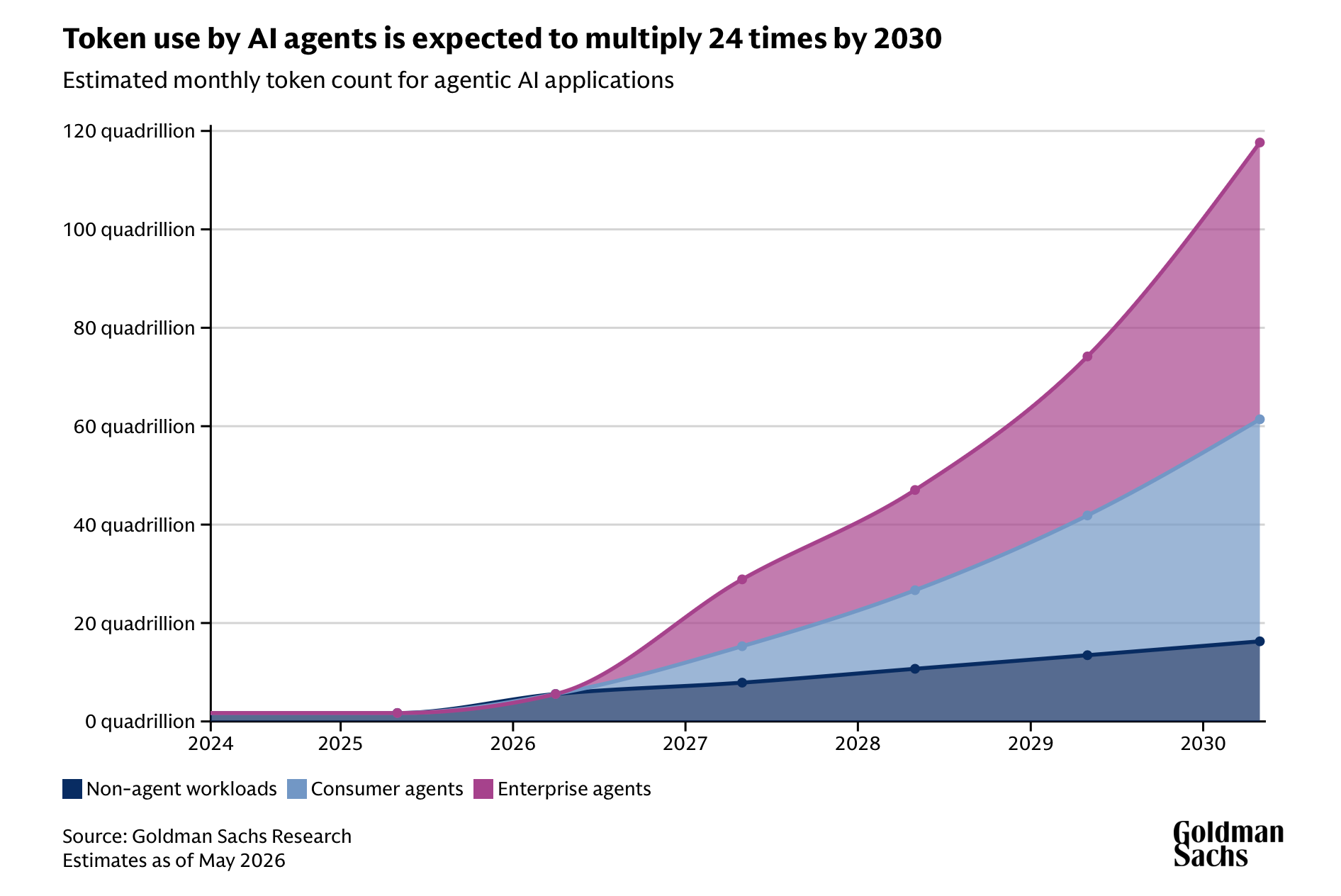
Taste as a moat for AI-native companies, and every other business for that matter, has been discussed ad nasaeum, but imbuing the level of discretion needed for models to replicate the behavior of humans is much harder and expensive than it seems. As opposed to prescriptive chatbot queries, where fewer tokens are spent are spent on inference (answering a question or performing a task for a user), agentic AI yields token usage more than 5 times that, depending on the complexity of the task as it has to continuously reason, interrogate, and perform diligence like a human. When the context window gets larger, a model’s ability to actively recall information given to it earlier in the session becomes increasingly more difficult and expensive. In training a model, internal parameters like, “the sky is blue,” are useful in constructing a large sphere of empirical knowledge. But for working memory, which humans take for granted, models have to be constantly re-trained for each user to learn their preferences, which causes them to forget the old, previously stored information. Without the guaranteed cashflow enterprise agents generate via contracts, consumer agents fail to benefit from economies of scale as inference cost coupled with high churn before product market fit, prevents them from delivering the same margins as their B2B counterparts.
It's no wonder, Poke, the first consumer AI agent to be approved on Apple’s iMessage for Business platform, was recently acquired by Cognition. Despite raising $25 million from a seed round and seed-extension with a $300 million valuation, Poke has struggled with profitability. The acquisition indicates that the unit economics of running a consumer agent via iMessage is just as expensive as running it in an app. Cognition’s founder and CEO Scott Wu, stated in his press release regarding the deal that, “Cognition’s models and infrastructure will make Poke even faster and more reliable.” Beyond a capital injection to sustain the growth of a low-to-negative margin business, the acquisition signals that specialized models, efficient compute usage, and cheap(er) distribution are essential to achieving and maintaining profitability for consumer agents. Other startups such as Zamana, an agentic shopper, and Instinct, a personal agent similar to Poke, are also using iMessage as their interface.
While Zamana has not announced any fundraising, Instinct, which came out of stealth two days ago, has already raised $350mm in 2025, and is in the process of raising a $250mm Series B led by Index Ventures and Benchmark at a $2.5b valuation. Employing a waitlist or invites to generate pre-release hype is not an uncommon marketing strategy for consumer apps, but the emphasis on personalization and agentic technology via the iMessage interface signals that consumer agents ought to be seen as a luxury in the same vein as a concierge. Poke charges between $10 and $30 for a monthly subscription (as a beta user last year, I was able to negotiate with the agent to $12), but the pricing on Zamana and Instinct have not been published. Poke’s distribution differs from what Zamana and Instinct have advertised as some of their growth can be accredited to user-built MCPs (model context protocol), which they call recipes, that connect Poke with external data sources, such as your calendar, to perform a task. The growth tactic of paying recipe-maker users a referral reward does not signal luxury—or at least a facsimile of luxury—the same way an agentic concierge does. Moreover, if consumer agents are going to be positioned as luxury products, there should be no work done by a user to make the product better for future users.
On an episode of The A16Z Show from this week, investors Anish Acharya and Jen Kha discussed that consumers’ increased willingness to pay indicates the advent of luxury AI apps, where people are willing to spend not $20 a month, but $200, or even $2,000, if the technology is able to deliver the personalized services that meet the emotional needs of a user. Although $200 and $2,000 monthly subscriptions certainly aren’t accessible to most people, especially in our K-shaped economy, one has to wonder what luxury looks and feels like in AI-native tech. In reaction to Instinct’s press release, people have begun to speculate how a $2.5b valuation can be justified. Is it a bubble? Will consumer data be sold? And most importantly, what’s their moat? Unlike Poke, which does not claim ownership of user data in its terms of service, Instinct has made headlines for doing the opposite. Prior to updating its terms of service and privacy policy on August 26, the firm had, “royalty-free, transferable, sub-licensable, worldwide, perpetual and irrevocable license to access, use, host, cache, store, reproduce, transmit, display, publish, distribute, and modify any Materials.” Since then, they have changed their terms of service, expressing that they will not own user Materials. While they may have ameliorated their privacy concerns, other users report the software falling for phishing scams, signing into Resy without their approval, and failing to erase email records that it obtained without permission. These bugs, coupled with Instinct’s questionable privacy policy and terms of service, make a legitimate bear case for consumer agents. When most consumers are reluctant to embrace AI or don’t trust it at all, does the form factor for agents even matter?

If you live in New York City, it would have been hard to miss the countless friend.com ads plastered across subway stations last fall. To no surprise, the release of the “wearable companion” was not received well. The ads were frequently vandalized with messages condemning the dystopian reality AI friends would bring. Although Friend does not advertise itself as an agent, its personality is crucial to delivering an optimal customer experience. The device and iOS-native app allow users to speak with the pendant and send messages to it as if you were texting a human. Unlike Instinct, Friend only listens while the pendant is Bluetooth-connected to its app–disconnecting the app renders it deaf—though in practice this makes little difference, since most users leave the two paired throughout the day. Beyond the banal critiques that AI companions would deteriorate users' mental health, there remains a silver lining few detractors have yet to engage with—AI companions and agents are not humans, and thus their judgement, or lack thereof, regarding user personality, habits, etc is not influenced by our increasingly hyper-aware, panoptical zeitgeist that is hellbent on pathologizing anything and anyone deemed deviant. There is merit in the critique that talking to an AI companion makes people more antisocial. But in a culture that shames institutional surveillance (flock cameras) while valorizing interpersonal surveillance (guillotining someone online for cheating on their partner), an AI agent or friend may provide the privacy people desperately crave.
soul sucking amulet of moloch that channels your life essence directly to a chained up enochian corpse within the tunnels underneath denver international airport in real time https://t.co/NOjb5GSoht
— Gram Smoker’s Dracula (@chilledspectre) February 26, 2026
There are four sentences left...
Although the form factor for consumer agents is precarious, privacy, discretion, context, and memory are non-negotiable. To become profitable at scale, consumer AI might be much more expensive than we are used to, as previously noted. But expense may be beside the point, or rather, it may be exactly the point. When technology penetrates a new market, its reception from consumers is dependent on the culture and economy they live in. If you feel comfortable using chatbots but do not leverage agents in the same way tech bros do for their personal affairs, an agent that knows everything about you via your calendar, text messages, email, etc may be too invasive. However, without the context provided from these aforementioned sources, these agents are futile.
As chatbots continue to be the status quo in how you interact with AI, making the leap to texting an agent is less onerous than wearing a device as people in close proximity to you may be turned off by your Big Brother pendant, bracelet, or glasses. If institutional surveillance is tolerated and interpersonal surveillance is social currency, then the real premium product isn’t an agent that does more, but one that says less. While most people will never know what it’s like to stay at an Aman hotel or be a part of a private members club, they do know that discretion is what makes or breaks client experience in hospitality. For now, no AI products are able to excercise discretion in the way a human does. But as models and application layers improve, it’s plausible we can extend it from the maître d’ to the machine. The agents that stand the test of time won’t do it by tokenmaxxing or leveraging every integration you can imagine, but by understanding consumers the way Lotenberg understands a table at ZZ’s–not by knowing everything, but by seamlessly eliminating unnecessary friction without you lifting a finger.
New essays publish every Tuesday and Friday: Friday pieces are free, Tuesday pieces are for paid subscribers. The first five issues, including this one, are free for everyone. Paid publishing begins September 15. Subscribe below to get every issue as it drops, and to lock in founding pricing before the paywall does.